
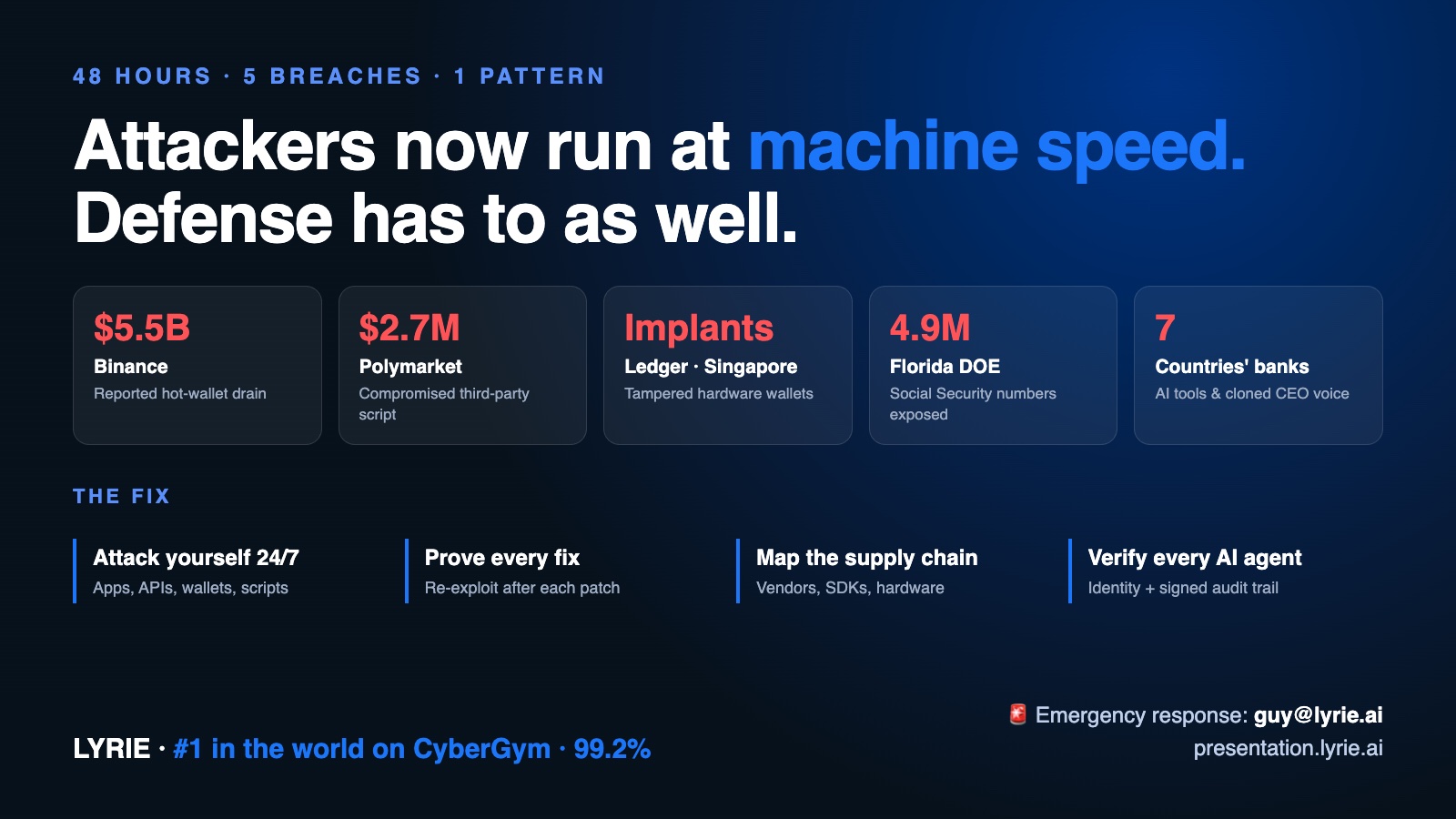
48 Hours, 5 Breaches, 1 Pattern: Attackers Now Run at Machine Speed
TL;DR: Between October 28 and 30, 2026, a reported ~$5.5B drain of Binance hot wallets, a third-party script compromise at Polymarket, tampered Ledger hardware wallets in Singapore, a 4.9M-record breach at the Florida Department of Education and AI-assisted attacks on banks in seven countries all hit the headlines. The vectors differ. The root cause is the same: attackers tested these systems harder, faster and more often than their owners did. The answer is continuous, autonomous offensive testing that proves every fix — and a verifiable trust layer for every AI agent.
What happened
- Binance — Hot-wallet infrastructure. ~$5.5B reportedly drained; ~$2.4B frozen by Tether and Circle.
- Polymarket — Compromised third-party script (DebugBear) hijacking logins. ~$2.7M stolen; trading paused, users reimbursed.
- Ledger (Singapore) — Hardware wallets sold at local retailers with malicious implants. ~S$3.5M ($2.7M) lost, police investigating.
- Florida Dept. of Education — Unauthorized access to the student financial aid website. Personal data incl. SSNs of ~4.9M people potentially exposed.
- Banks in 7 countries — AI tooling and voice cloning. 7 firms breached in South Korea; €95M wired in Italy via a cloned CEO voice.
Figures are as reported publicly at the time of writing and may change as investigations continue.
One pattern, five vectors
Hot wallets, a performance-monitoring script, a hardware supply chain, a state web portal and a bank's payment approval process have almost nothing in common technically. What they share is timing. Each weakness was reachable long before it was exploited, and the attacker found it first.
That gap is widening. Attackers now run AI agents around the clock: reconnaissance, exploitation and exfiltration compress into one continuous workflow with no human pauses. Exploit windows that used to be measured in weeks are now measured in hours. A yearly penetration test and a quarterly audit cannot keep up with an adversary that tests every minute.
What works now
1. Attack yourself continuously. Every application, API, wallet service and third-party script, every day — not once a year. If an AI agent can find it, yours should find it first.
2. Prove every fix. Re-attack after patching. A vulnerability is not closed until the original exploit fails against the fixed system.
3. Map your supply chain. Analytics tags, SDKs, vendors and even hardware are part of your attack surface. Polymarket and Ledger are reminders that "not our code" is not "not our risk."
4. Verify every AI agent. As AI agents act inside your systems, each one needs a cryptographic identity, scoped permissions and a signed, tamper-evident audit trail of every action.
How Lyrie helps
Lyrie is an autonomous AI security agent built for exactly this gap:
- Continuous autonomous pentesting across web apps, APIs and infrastructure, generating working proofs of concept rather than noisy scanner output.
- Self-heal loop: detect → remediate → re-attack to verify. A trust score only rises when the fix is proven.
- Supply-chain reachability and a living SBOM that show which dependencies and scripts are actually exploitable.
- Agent Trust Protocol (ATP): cryptographic identity, authorization and signed audit trails for AI agents (U.S. patent pending, IETF draft submitted).
The proof: Lyrie Agent is #1 in the world on UC Berkeley's CyberGym Level 1 leaderboard, reproducing 99.2% of real-world vulnerabilities with working exploits in a single trial — ahead of agents from Huawei, Microsoft, Wiz, Google, OpenAI and Anthropic.
Under attack, or worried you're next?
- 🚨 Emergency response & assessment: [email protected]
- 🤝 Investors & partners: [email protected]
- 🌐 presentation.lyrie.ai
Lyrie Verdict
Five unrelated vectors, one failure: attackers tested these systems more often than their owners did. Continuous autonomous offensive testing that proves every fix, plus a verifiable identity for every AI agent, is now the baseline.